

Research Center for Agriculture under Climate Change | Volcani Institute

Events and seminars

Webinar:
Climate Change: What Are the Consequences for Poultry Today and in the Future? Modeling to Predict and Anticipate
The Research Center for Agriculture under Climate Change at the Volcani Institute invites you to an online webinar with Dr. Yann Guyot:
Climate Change: What Are the Consequences for Poultry Today and in the Future?
Modeling to Predict and Anticipate
Opening remarks will be delivered by Dr. Shelly Druyan, Head of the Institute of Animal Sciences at the Volcani Institute.
20 October 2026
14:00
Online
Participation is free.
Research, Innovation and Collaboration at the 7th Field Crops and Vegetables Conference
The 7th Conference of the Israeli Scientific Society for Field Crops and Vegetables was held on September 15, 2026, at the Robert H. Smith Faculty of Agriculture, Food and Environment at the Hebrew University of Jerusalem.
The event brought together researchers, farmers, students and industry representatives for a day of scientific discussion, research presentations and professional exchange.
The scientific program centered on five themes: sustainable agriculture in a changing climate, responses to biotic and abiotic stresses, precision agriculture, carbon farming, and emerging approaches to the genetics and breeding of vegetables, field crops and forage.
The session on sustainable agriculture was sponsored by the Research Center for Agriculture under Climate Change at the Volcani Institute. Presentations examined nonchemical weed control, soil health and fertility, sorghum production for greater food security, and the effects of climate change on the spread of viral diseases in watermelon and melon crops.
The session on precision agriculture, agroinformatics, modeling and phenomics was sponsored by the Israeli Center for Digital Agriculture. Topics included crop-canopy temperature regulation, wheat-yield modeling, the conservation of crop wild relatives, and the detection of invasive weeds using remote sensing and deep learning.
The session on carbon farming in Israel was sponsored by Future Crops for Carbon Farming (FCCF), the Israeli Center for Carbon Farming. The presentations addressed methods for monitoring soil health and carbon sequestration, the relationship between growth rate and wheat yield, the renewal of sesame cultivation in Israel, and lessons from six years of regenerative agriculture.
Additional sessions explored plant defense mechanisms against pests and pathogens, the effects of environmental stresses on plant development, and new approaches to breeding wheat, strawberries, tomatoes and peanuts. The first part of the genetics and breeding session was sponsored by Dalia Seeds.
The program also featured one-minute poster presentations, a poster exhibition and a keynote lecture by Dr. Itay Gonda on challenges and solutions in modern spice-crop breeding.
The conference concluded with an awards ceremony recognizing students for outstanding oral and poster presentations.
We thank the Israeli Scientific Society for Field Crops and Vegetables, the conference organizers, session chairs, speakers and all those who participated.
Special thanks are extended to the organizations and companies that supported the conference: the Field Crops Growers Organization, the Vegetable Growers Organization, Future Crops for Carbon Farming (FCCF), the Israeli Center for Digital Agriculture, the Robert H. Smith Faculty of Agriculture, Food and Environment, the Agricultural Research Organization, Volcani Institute, the Research Center for Agriculture under Climate Change, the Schoenberger Center for Plant Sciences in Agriculture, KANAT, Dalia Seeds, and the Miriam and Prof. Rafael Frenkel Foundation.
September 2026


Volcani Researchers at the 32nd International Horticultural Congress
A large delegation from the Volcani Institute took part in the 32nd International Horticultural Congress in Kyoto, one of the major international meetings in horticultural research.
Volcani scientists presented studies, chaired scientific sessions and joined discussions on climate stress, crop resilience, sustainable production, fruit quality and the reduction of food loss. The congress also provided an opportunity to exchange knowledge with colleagues from around the world and develop new professional and research connections.
The delegation included Carmit Ziv, David Ezra, Tamar Shemer, Dana Charuvi, Noam Alkan, Yael Grunwald, Itay Maoz, Amnon Lichter, Gilor Kelly, Gal Wittenberg and Vered Irihimovitch. Avi Sadka, Yuval Cohen, Hagai Yasuor, Maya Kleiman, Helena Vitoshkin, Lior Blank and Omer Frenkel also participated in the congress.
Their contributions reflected the breadth of horticultural research at the Volcani Institute, from plant genetics and physiology to crop management and postharvest science.
Preparing Horticultural Crops for Hotter Growing Conditions
How plants respond to heat depends on their genetics, physiology, stage of development and growing environment. Research presented by Volcani scientists at IHC2026 addressed these factors across a wide range of crops and production systems.
Tamar Shemer examined whether photosynthesis in the stems of a wild almond relative could contribute to the development of more climate-resilient almond varieties. Yael Grunwald compared the responses of apple cultivars and rootstocks to heat stress, while Hagai Yasuor studied how high autumn temperatures affect strawberry development, flowering and metabolism.
Research on fruit trees included Yuval Cohen’s work on the regulation of mango flowering under the extreme desert conditions of the Dead Sea and Arava regions. Dana Charuvi presented evidence that chemical priming can improve the ability of avocado trees to withstand temperature stress and can produce yield benefits that persist beyond the initial treatment.
Other studies introduced new traits and technologies for breeding and crop management. Maya Kleiman investigated whether the structure and biomechanics of plant surfaces could be used in selecting more resilient crops. Gilor Kelly presented an in planta genome-editing method for citrus and chaired a session on transformation and delivery technologies. Helena Vitoshkin presented a real-time machine-learning model for irrigation and fertilization in hydroponic systems, as well as work on greenhouse screens that alter the light spectrum available for photosynthesis.
Taken together, the studies show that adapting horticulture to climate change will depend on work at several levels, from individual genes and physiological processes to the management of orchards, greenhouses and irrigation systems.


The Second Agriculture and Climate Conference: Innovative Solutions for Climate Challenges
The second Agriculture and Climate Conference will be held on November 11, 2026, with a focus on innovative responses to the challenges climate change presents to agriculture.
Rising temperatures, declining water availability and more frequent extreme events are already affecting crop production and livestock systems. Responding to these changes requires a clearer understanding of their effects, alongside practical tools that can be applied in agricultural research and production.
The conference will bring together researchers, extension specialists and agricultural professionals to discuss current findings and approaches for reducing climate-related risks and strengthening the resilience of Israeli agriculture.
The full program and additional information will be published closer to the event.

Supporting Sustainable Crop Management under Climate Change
The 7th Conference of the Israel Society of Crop and Vegetable Sciences will take place on September 15, 2026, at the Robert H. Smith Faculty of Agriculture, Food and Environment in Rehovot.
The Research Center for Agriculture under Climate Change is sponsoring the conference’s first scientific session, which will examine how crop management can support more sustainable agriculture under changing climatic conditions.
The session will include studies on nonchemical weed control in organic field and vegetable crops, practices for improving soil health and fertility in intensive greenhouse production, the potential of sorghum to strengthen food security and the role of changing winter conditions in the spread of a viral disease affecting watermelon and melon crops.
The conference brings together researchers, extension specialists, growers and other agricultural professionals to discuss current research and its application in the field.

Volcani Institute and Ministry of Environmental Protection Hold Joint Forum on Climate Change and Agriculture
Researchers from the Volcani Institute and professionals from the Ministry of Environmental Protection gathered this week for a joint professional forum dedicated to climate change, agriculture, and environmental research.The meeting brought together nearly 50 participants from both organizations and provided an opportunity to share ongoing research activities, discuss emerging challenges, and identify opportunities for future collaboration. The forum covered a range of topics related to climate resilience, environmental monitoring, agricultural sustainability, and the development of science-based solutions to support decision-making.As climate change continues to affect agricultural systems and natural resources, effective collaboration between researchers and government agencies is becoming increasingly important. Scientific research plays a critical role in advancing understanding of climate-related risks, while policymakers are responsible for translating knowledge into practical strategies, regulations, and management frameworks.The discussions highlighted the importance of maintaining regular dialogue between research institutions and government bodies, ensuring that scientific findings can inform policy development and that research efforts remain aligned with national environmental and agricultural priorities.The forum also created a platform for strengthening existing partnerships and exploring new areas for joint initiatives in the years ahead, with the shared goal of improving resilience to climate change and supporting sustainable agricultural and environmental management in Israel.
June 2026


Volcani Institute Researchers Present New Wheat Research at IWC2026
Researchers from the Volcani Institute recently participated in the International Wheat Congress 2026 (IWC2026) in Bologna, Italy, one of the leading global events dedicated to wheat research. The congress brought together scientists, breeders, agronomists, and industry professionals from around the world to discuss advances in wheat genetics, breeding, agronomy, sustainability, and climate resilience.
As climate change continues to challenge agricultural production systems worldwide, improving the resilience and productivity of wheat remains a major scientific and agricultural priority. At the congress, Volcani Institute researchers presented studies addressing key aspects of wheat performance under water-limited and variable environmental conditions.
Dr. Roi Ben David presented research examining the genetic and physiological basis of stem structural biomass in wheat under Mediterranean drought conditions. The study highlights how stem traits can contribute to grain filling and help maintain yield stability during terminal drought, offering insights that may support the development of more resilient wheat varieties.
Dr. Ehud Strobach presented a high-resolution coupled crop-climate modeling approach for evaluating wheat yield efficiency in Israel’s dryland regions. By integrating climate and crop models, the research provides a framework for assessing the impacts of climatic variability and supporting climate-informed, site-specific agricultural management.
Together, these studies contribute to ongoing international efforts to strengthen wheat resilience, improve productivity, and support food security under changing environmental conditions.
May 2026


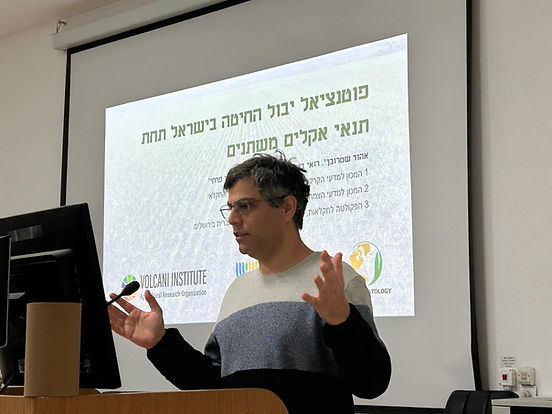
Research Center for Agriculture under Climate Change Showcases Its Activities at "Zor'ot Et HaAtid" Conference
The Research Center for Agriculture under Climate Change at the Volcani Institute participated in "Zor'ot Et HaAtid", the flagship conference of Israel's Ministry of Agriculture and Food Security dedicated to promoting women's leadership in Israeli agriculture.
As part of the conference, the Center showcased its activities through a poster presenting its multidisciplinary approach to advancing agricultural research under changing climatic conditions.
The poster highlighted the Center's research platforms and ongoing efforts in areas including climate adaptation, environmental monitoring, phenotyping technologies, modeling approaches, and collaborative research initiatives that support climate resilient agriculture in Israel.
The Center brings together researchers from multiple disciplines and institutions to address some of the key challenges facing agriculture under climate change. By integrating field experiments, advanced monitoring technologies, and data driven approaches, the Center works to bridge fundamental research and practical applications that can support more resilient and sustainable agricultural systems.
The conference provided an opportunity to present the Center's activities to researchers, professionals, and students from across Israel, while fostering new collaborations and strengthening connections within the agricultural research community.

Research Center Hosts Scientific Workshop on Lysimeter Systems and Plant Physiology


Researchers from across the Volcani Institute participated in a scientific workshop organized by the Research Center for Agriculture under Climate Change, focusing on the use of lysimeter systems as a research platform for plant physiology and agricultural research.The workshop presented the PlantDitech lysimeter system and its applications in studies addressing drought tolerance, plant physiological responses, carbon fixation, and abiotic stress under changing environmental conditions. Researchers demonstrated how high throughput physiological monitoring systems can support data driven agricultural research and improve understanding of dynamic plant environment interactions.Among the presentations:Dr. Dan Zeira presented research on photosynthetic stem traits in wild almond and their role as alternative carbon fixing tissues in almond tree physiology.Dr. Gilor Kelly presented research on stomatal function and plant physiological regulation.Dr. Dani Eshel presented research on sugar metabolism reprogramming in potato and its role in abiotic stress tolerance.Dr. Rakefet David Schwartz presented studies using lysimeters to investigate drought tolerance in forest trees.Karen Moshleion from PlantDitech presented the technological capabilities of the PlantArray gravimetric platform and its use for studying dynamic interactions between plants and their environment.The workshop highlighted the value of advanced phenotyping and physiological monitoring systems for agricultural research under climate change and provided an opportunity for interdisciplinary scientific discussion across research fields at the institute.
May 2026
Presentation at the EGU General Assembly 2026

Dotan Perlstein, a PhD student from the Agroclimatology Lab, presented his work at the annual European Geosciences Union (EGU) General Assembly, held in Vienna from May 3–8, 2026.
His presentation, titled “Establishment of the Israeli Soil Moisture Monitoring Network”, focused on the development of Israel’s soil moisture and temperature monitoring network and its role in advancing agroclimatic and environmental research.
The monitoring network provides valuable long-term data for studying soil-water dynamics under changing climatic conditions and supports research related to agricultural resilience, water management, and climate adaptation.
The EGU General Assembly is one of the leading international conferences in the geosciences field, bringing together researchers from around the world to present and discuss recent scientific advances.
We are proud to see this important research presented on an international stage.
May 2026


Strengthening Collaboration Between Agricultural and Meteorological Research
On April 28 2026, the Center for Agricultural Research under Climate Change at the Volcani Institute hosted a delegation from the Meteorological Service for a professional visit.
The program included a tour of the center’s research facilities and a demonstration of the Phenomobile platform. During the meeting, Dr. Roi Ben-David presented the center’s activities and collaborations, and Dr. Ehud Strobach presented developments in high-resolution data integration and soil-based measurement networks.
The discussion highlighted the value of integrating meteorological data into agricultural research and identified opportunities for future collaboration.
April 2026

A New Drought-Resistant Wheat Variety Developed at Volcani Institute
A recent article published by The Times of Israel highlights the development of a new drought-resistant wheat variety at the Volcani Institute, created as part of ongoing efforts to strengthen Israeli agriculture under changing climate conditions.
The new variety, “Ya’akobi,” was developed by Dr. Roi Ben-David and his research team. It is characterized by early maturation, resistance to drought and heat stress, and adaptation to challenging growing conditions, particularly in southern Israel. The development of resilient crop varieties such as this is becoming increasingly important for addressing the impacts of climate change on agriculture and strengthening future food security.
The variety was named in memory of agronomist Yaakov (“Ya’akobi”) Inon, who was murdered alongside his wife Bilha during the October 7, 2023 terrorist attack on Moshav Netiv Ha’asara. Over the years, Inon played a significant role in Israeli agriculture and field crop research, working closely with both farmers and researchers.
The development of the “Ya’akobi” variety reflects the connection between advanced scientific research and a deep commitment to Israeli agriculture and to the people who dedicated their lives to it. For the full article
April 2026


Thank You to All Participants of the Seminar:
Agriculture and Climate Change – Adaptation and Mitigation | Neve Ya’ar 2026
The seminar focused on the challenges facing Israeli agriculture under climate change, while fostering connections between applied research and adaptation and mitigation strategies.
The discussions throughout the day highlighted both the challenges and opportunities emerging at the intersection of agriculture, research, and policy, as well as the important role agriculture plays in addressing climate change.

.jpeg)
.jpeg)
.jpeg)
Webinar #2
The center’s second webinar featured Prof. Heribert Hirt, Head of the Darwin21 Desert Research Initiative at King Abdullah University of Science and Technology (KAUST).
In his lecture, “Harnessing the desert plant–soil–microbiome for ensuring food safety under climate change conditions,” Prof. Hirt demonstrated how desert plant–soil–microbiome systems can offer innovative solutions
Webinar
On July 3, 2025, the center's first webinar took place, hosted by Prof. Senthold Asseng from the Technical University of Munich,
In the lecture “The Impact of Climate Change on Wheat"
The webinar was held in collaboration with the FCCF Consortium and was attended by researchers and professionals from a variety of fields.
2025 Agriculture-Climate Conference
On March 19, 2025, a conference was held on "Agriculture-Climate: New Research and Interfaces for Climate Challenges," initiated by extension Service at the ministry of Agriculture and Food Security, the Center for Agriculture under Climate Change, and in collaboration with the Office of the Chief Scientist of the Ministry of Agriculture.
The conference dealt with the effects of climate change on the agricultural sectors in Israel, and innovative ways to deal with environmental challenges in order to ensure food security.
During the day, current research from the field, the institute, and academia was presented, in diverse areas such as adapting agricultural interfaces to changing climate conditions, developing resistant varieties, optimized irrigation methods, hormonal applications, and more.


Opening Conference – Research Center for Agriculture under Climate Change, 2024
The conference opened with a ceremony to inaugurate the quarantine cell array.
In the presence of Mr. Oren Lavie, Director General of the Ministry of Agriculture
and representatives of the Ministry of Agriculture, the management of the Agricultural Research Directorate and the Plant Protection and Inspection Services.
In addition to the presentation of the center's infrastructure by Dr. Roy Ben David, director of the center.
Scientific lectures were presented in the fields of modeling and forecasting, plant protection, and climatic studies in the olive and tomato sectors in Israel.
Finally, an overview of the effects of climate change on Israeli agriculture was given by Dr. Amir Givati, Director of the Meteorological Service.
We set off.
Hoping for fruitful joint work


