

Research Center for Agriculture under Climate Change | Volcani Institute
Alley-cropping research site –
an on-farm platform for agroforestry research
Led by Dr. Oren Shelef


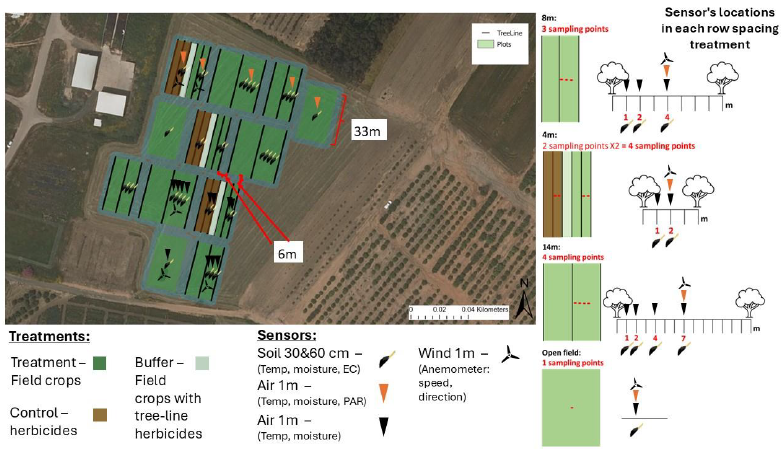
An alley-cropping research site has been established at the Agricultural Research Organization (ARO) – Volcani Institute and is open for stakeholder collaboration. The site is located in central Israel (31°59'14.99"N, 34°49'1.69"E) with a mean annual precipitation (MAP) of 540 mm. For further details, please contact Dr. Oren Shelef, signed below.
Research design. Olive tree rows are designed for mechanical harvesting, with an ultra-dense spacing of 1.6 m between trees. Korniaki cultivar olive saplings were planted in May 2023. The trees are irrigated and fertilized during the summer. Rain-fed winter field crops are cultivated between the tree rows (1st year – clover; 2nd year – wheat, cv. Ruta).
The alley-cropping experiment is arranged in three blocks, each including five treatments:
1. OF – monoculture field crop;
2. 14 – olive tree rows with 14m alley width;
3. 8 – olive tree rows with 8m alley width;
4. 4 – olive tree rows with 4m alleys (common practice), intercropped with field crops;
5. 4control – olive tree rows with 4m alleys, without field crops or herbaceous vegetation (maintained with chemical herbicides).
In each plot, measurements are taken from the central tree row, while the outer rows serve as buffer zones to minimize edge effects.
Consecutive data acquisition. Sensor locations are illustrated. The icons represent soil sensors measuring temperature and volumetric water content (VWC) (Soil Scout, Finland) at two depths: –30 cm and –60 cm. The soil sensors have been continuously active since April 2024 and are designed to transmit data hourly for up to thirty years. Climate stations provide microclimatic data, including relative humidity, wind speed and direction (anemometers), air temperature, and photosynthetically active radiation (PAR). 45 dendrometers consecutively measure trunk diameter on 3 trees per measurement tree line. Additional climate stations are planned for installation on 2026.
Periodical data monitoring: To support the development of crop growth models, drone imaging is conducted twice a year – at the end of summer and prior to field crop harvest. Soil properties are measured at the 36 sensor locations, including C/N ratio, NPK content, bulk density, and soil texture. Solar irradiation and leaf area index (LAI) are measured using a SunScan system (Delta-T Devices). Tree trunk diameter was recorded manually and soon consecutively by dendrometers. Olive yield is assessed. Herbaceous plant phenology and biomass growth are monitored regularly. Soil biodiversity is sampled and analyzed each spring.