top of page


Research Center for Agriculture under Climate Change | Volcani Institute
Publications
What Does the Future of Wheat Production Look Like in a Changing Climate?
Wheat production across the Middle East is increasingly exposed to high temperatures, water scarcity and shorter, less predictable rainy seasons. A regional research project is examining how wheat breeding can respond to these conditions without compromising yield or bread-making quality.
Launched in 2020, the project brought together Israeli, Palestinian and Dutch scientists. The researchers evaluated approximately 300 wheat lines and selected 18 for further testing.
One of these lines was named “Ufuq,” the Arabic word for “horizon.” Over three years of trials, Ufuq produced good yields while retaining characteristics important for bread making. It remains an experimental line and is not currently available to farmers.
The project was led by Prof. Zvi Peleg and Prof. Ziad Abdeen, with Dr. Roy Sadeh, Dr. Roi Ben-David, Dr. Ittai Herrmann, Tony Mamin and a wider group of researchers from the Hebrew University of Jerusalem, Al-Quds University, Wageningen University & Research and the Volcani Institute.
The work illustrates the value of regional scientific cooperation in addressing a challenge shared across borders: maintaining wheat production as growing conditions become hotter and drier.
Read more

Can Wheat Stems Help Protect Grain Yield under Drought?
Plants must divide their resources between vegetative structures and reproduction. In wheat, this has led to the assumption that greater investment in the stem may come at the expense of grain production. A new study suggests that under drought, the opposite may be true.
The researchers evaluated 295 bread wheat lines in three Mediterranean environments with different levels of water availability. Heavier and wider stems were associated with larger grains and higher yield per spike, with the clearest relationships observed under terminal drought.
Wheat stems do more than support the leaves and spike. They can store water-soluble carbohydrates that become available for grain filling when drought restricts photosynthesis. The study also identified genomic regions associated with stem structure and revealed a genetic constraint between stem diameter and solidness that breeders will need to consider when selecting for these traits.
Models that accounted for differences in genetic performance among environments improved prediction accuracy by 46.5 percent. The results provide useful markers and selection tools for developing wheat varieties better suited to dry and variable Mediterranean conditions.
The study was conducted by Simeon Ntawuguranayo, Roy Sadeh, Hanan Sela, Ittai Herrmann, Zvi Peleg and Roi Ben-David.
Read the paper

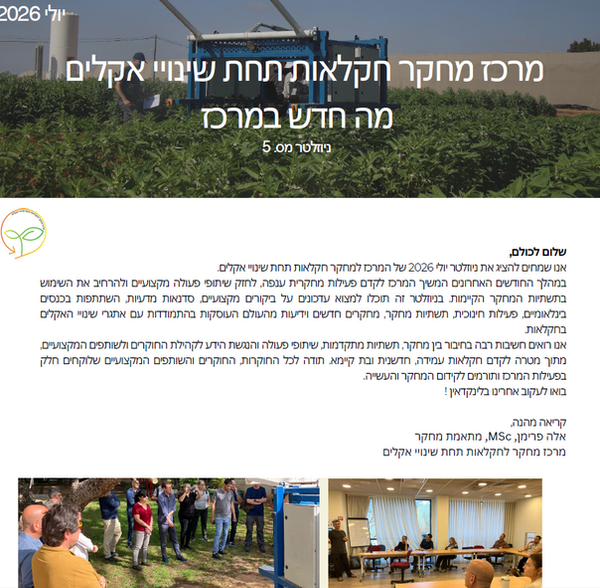
July 2026 Newsletter: Research, Collaboration and Climate Resilience
The fifth issue of the Center’s newsletter provides a closer look at the research, facilities and partnerships shaping our recent work.
This issue covers a professional visit by senior representatives of the Israel Meteorological Service, a workshop on the use of the PlantArray phenotyping platform and research presented by Volcani scientists at international conferences. It also features the Center’s quarantine facilities for imported plant material and plant pathogens, and a science outreach activity for ninth-grade students.
The research section examines the contribution of carbohydrate reserves in wheat stems to grain filling under Mediterranean drought conditions. Other stories address Israel’s soil moisture and temperature monitoring network and the growing threat that extreme heat poses to agriculture and food production.
The full July 2026 newsletter is available here.


Dr. Roi Ben-David explains the vision of the center
bottom of page